Bodysee · Local Motion Lab
One ordinary camera powering posture support and six motion games
Local AI & Motion Interaction Case / 11
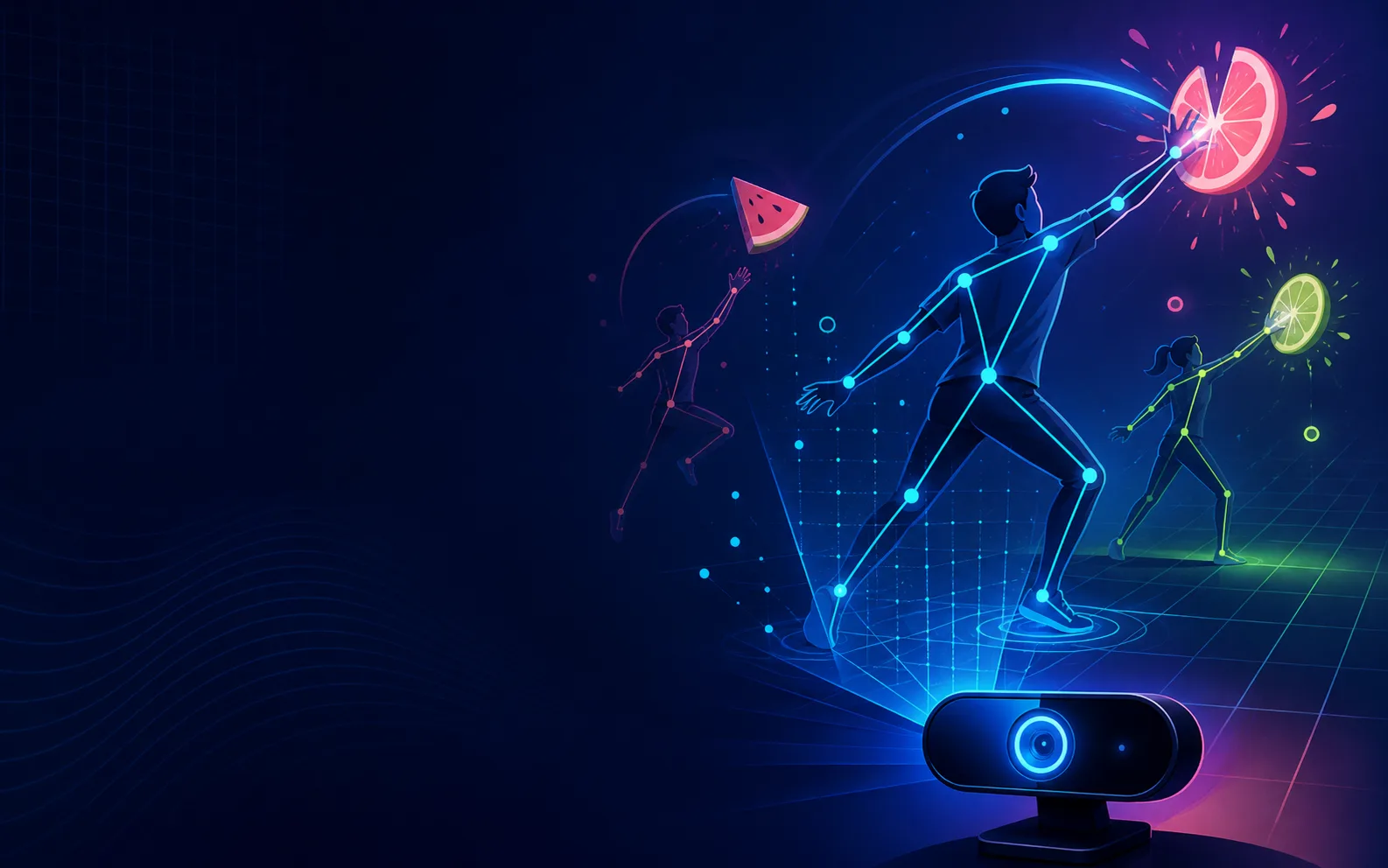
Bodysee uses one ordinary camera and one pose-recognition foundation to power posture support and six motion games.
Using thirty-three MediaPipe landmarks, the system emphasizes personal calibration, low-frequency sampling, consecutive anomaly confirmation, and local privacy. Game modes translate wrists, leaning, squatting, and arm extension into slicing, rhythm, running, puzzles, and shooting.
Supports macOS and Windows and runs offline after the initial model download.
Frames are processed in memory and are neither stored nor uploaded.
Posture monitoring uses a personal baseline, three-frame median, and three consecutive anomaly samples.
The fruit-slicing mode has been locally play-tested with a camera; other modes are implemented in the same source.
Control False Alerts Before Daily Use
Fixed angles cannot fit every body and camera position, so the system first calibrates a ten-second personal baseline, takes the median of three frames, and requires three consecutive anomalies before alerting.
Low-frequency sampling reduces CPU load, cooldowns prevent alert fatigue, and absence resets sitting duration. These state-machine rules matter more to usability than single-frame accuracy.
One Capability, Multiple Body Interactions
Games require no controller. Wrist speed, body center, shoulder-hip height, and arm span become explicit actions. Camera and debug-input modes separate recognition issues from gameplay issues.
Visuals and audio are largely generated programmatically, reducing asset dependency and keeping focus on motion feedback, rhythm, and tolerance.
PROCESS
Key Decisions
Personal calibration first
Judge posture relative to a personal baseline instead of treating one body as universal.
Local privacy by default
Camera frames are neither stored nor uploaded, reducing privacy friction for persistent use.
Separate recognition from gameplay testing
Mouse and keyboard debug modes validate interaction rules without a camera.
Role & Collaboration
Starting from a personal posture need, I shaped the monitoring state machine, privacy boundary, cross-platform launch flow, and several motion-game concepts.
AI supported implementation, game expansion, and documentation; I owned experience goals, false-alert trade-offs, privacy principles, and local play-testing.
Validation, Outcome & Reflection
The local code is runnable, and the fruit-slicing mode has been tested with a real camera.
Different devices, lighting, body framing, and Windows environments still need broader compatibility testing.
The key to a computer-vision product is not merely recognizing a person, but turning unstable signals into a predictable, recoverable everyday experience.
DEMO / 11
Motion product demo · 37 sec
A 720p landscape play-test showing camera recognition, body-motion mapping, combo feedback, and motion gameplay.